

Reaching out to investors for the first time can feel intimidating. After spending months, or even years, building your startup, crafting the perfect pitch, and refining your product, it all comes down to a single email that determines whether someone responds or scrolls past. While many founders assume a lack of replies means investors aren't interested, the reality is often more nuanced.
Investors receive hundreds of emails every week from founders seeking funding, partnerships, or advice. With limited time and countless opportunities to evaluate, they quickly scan each email to decide whether it's worth a closer look. A lengthy introduction, a generic message, or an unclear value proposition can cause even a promising startup to be overlooked.
The good news is that cold emails still work. Many successful founders have secured meetings, built relationships, and even raised funding through thoughtful cold outreach. The difference isn't about using persuasive buzzwords or flashy language; it's about presenting your startup in a way that is relevant, credible, and easy for investors to understand within seconds.
In this guide, you'll learn how to write investor cold emails that stand out for the right reasons. We'll explore why most outreach emails go unanswered, what investors actually look for when reading a cold email, how to structure a message that earns replies, and the common mistakes that prevent founders from getting noticed. Whether you're raising your first pre-seed round or looking for growth-stage investment, these practical strategies will help you make every email count.
Why Most Investor Cold Emails Never Get a Reply
For many founders, sending a cold email to an investor can feel like a numbers game. They create a list of investors, send dozens of messages, and wait for responses. When replies don't come, it is easy to assume that investors are simply not interested.
1. The Problem Is Often the Message, Not the Startup
However, the problem is often not the startup itself—it is the way the opportunity is communicated. Investors receive a constant stream of emails from founders looking for funding, introductions, or advice. Because they have limited time to evaluate hundreds of opportunities, they quickly decide which messages deserve attention. Within a few seconds, they are looking for signs that help them answer important questions: Is this startup relevant to my investment focus? Does this founder understand the market? Is there enough evidence to suggest this could become a valuable opportunity?
2. Investors Need Clarity Before They Need More Information
Most cold emails fail because they make investors work too hard to find these answers. They may include long company histories, vague descriptions, excessive industry jargon, or requests that are too broad. Instead of creating curiosity, these emails create confusion.
3. A Strong Cold Email Makes the Opportunity Easy to Understand
A strong investor cold email does the opposite. It respects the investor's time by making the opportunity clear, highlighting the most important information, and showing why there is a meaningful reason to start a conversation.
4. Understanding Investor Expectations Is the First Step
Understanding why emails fail is the first step toward writing outreach that gets noticed. Before focusing on templates or subject lines, founders need to understand how investors evaluate opportunities and what makes an email worth replying to.
The Anatomy of a Cold Email That Gets Replies
A successful investor cold email is not about writing the longest explanation of your startup or sharing every detail about your journey. It is about presenting the right information in the right order.
Investors do not need to understand everything about your company in the first email. The goal of your outreach is simpler: create enough interest and trust for them to take the next step, whether that means replying, asking for more information, or scheduling a conversation.
A strong cold email usually includes six key elements: a clear subject line, a personalized opening, a concise startup introduction, evidence of traction, a reason for reaching out to that specific investor, and a simple call to action.
1. A Clear and Specific Subject Line
Your subject line is the first opportunity to capture an investor's attention. A vague subject line can make your email look like another generic fundraising request, while a specific one immediately gives context about your company.
Avoid subject lines like:
- "Investment opportunity"
- "Seeking funding"
- "Startup pitch"
These tell investors what you want, but not why they should care.
Instead, focus on clarity and relevance. A stronger subject line communicates what you do, your progress, or why the investor may be interested.
For example:
Weak: Investment opportunity in our startup
Better: AI platform helping small businesses automate customer support
The goal is not to create mystery—it is to help the investor quickly understand why your email may be relevant to them.
2. A Personalized Opening That Shows Relevance
The first sentence should make it clear that this email was written specifically for that investor.
Many founders make the mistake of starting with a long introduction about themselves or their company. However, investors are more likely to engage when they immediately understand why they were contacted.
A personalized opening can reference:
- A company they have invested in
- Their investment thesis
- A market they focus on
- A recent article, announcement, or viewpoint they shared
For example:
"I noticed your investment in healthcare AI companies, especially your work with [Company]. Since we are building an AI solution that helps hospitals reduce administrative workload, I thought our approach may align with your investment focus."
This shows that the founder has done research and understands the investor's interests.
3. A Simple Explanation of What Your Startup Does
After establishing relevance, explain your company clearly and quickly.
Many founders assume investors need the full background story, but a cold email is not the right place for a detailed pitch. Your goal is to help someone understand the opportunity within a few sentences.
A strong startup description answers:
- What problem are you solving?
- Who experiences this problem?
- How are you solving it differently?
Instead of:
"We are revolutionizing the future of business operations through innovative AI-powered solutions."
Use:
"We help online retailers reduce customer support costs by using AI agents that resolve common customer queries automatically."
The second version is specific, easier to understand, and gives the investor a clear picture of the business.
4. Evidence That Shows Why Your Startup Matters
Investors are not only interested in ideas—they are interested in signals that suggest an idea can become a valuable company.
This is where founders should include their strongest evidence, such as:
- Revenue growth
- User growth
- Customer adoption
- Partnerships
- Market validation
- Previous founder experience
For example:
Instead of saying:
"We are growing quickly."
Say:
"We have grown from 500 to 8,000 users in six months and currently work with 20 paying businesses."
Specific numbers create credibility because they allow investors to understand your progress.
5. Why You Are Reaching Out to This Investor
A common mistake founders make is sending the same email to every investor. While personalization takes more effort, it significantly improves the quality of outreach.
Investors want to understand why their expertise, portfolio, or investment focus makes them a suitable partner.
Explain the connection:
- Why does your startup fit their portfolio?
- Why is this the right stage?
- Why might they understand your market?
A sentence showing alignment can transform a generic fundraising email into a thoughtful introduction.
6. A Clear and Low-Pressure Call to Action
The purpose of a cold email is not to force an investor into making a decision. It is to open a conversation.
Avoid asking for too much too soon:
"Can we schedule a one-hour meeting next week?"
Instead, make the next step simple:
"Would you be open to a brief conversation to explore whether this aligns with your investment focus?"
A clear but respectful request makes it easier for investors to respond.
The Goal: Make the Investor's Decision Easier
Every part of your cold email should answer one question: Why should this investor spend time learning more about this opportunity?
The strongest emails are not the ones with the most information. They are the ones that communicate relevance, credibility, and potential with the least amount of friction.
A Proven Cold Email Formula: The CLEAR Framework
Writing a cold email to an investor becomes much easier when you have a clear structure to follow. Many founders struggle because they start without knowing what information matters most. They explain their entire startup story, add unnecessary details, and only mention the reason for reaching out at the end.
A strong investor email should follow a simple flow: explain the context, communicate the opportunity, provide evidence, show why the investor is a good fit, and make the next step easy.
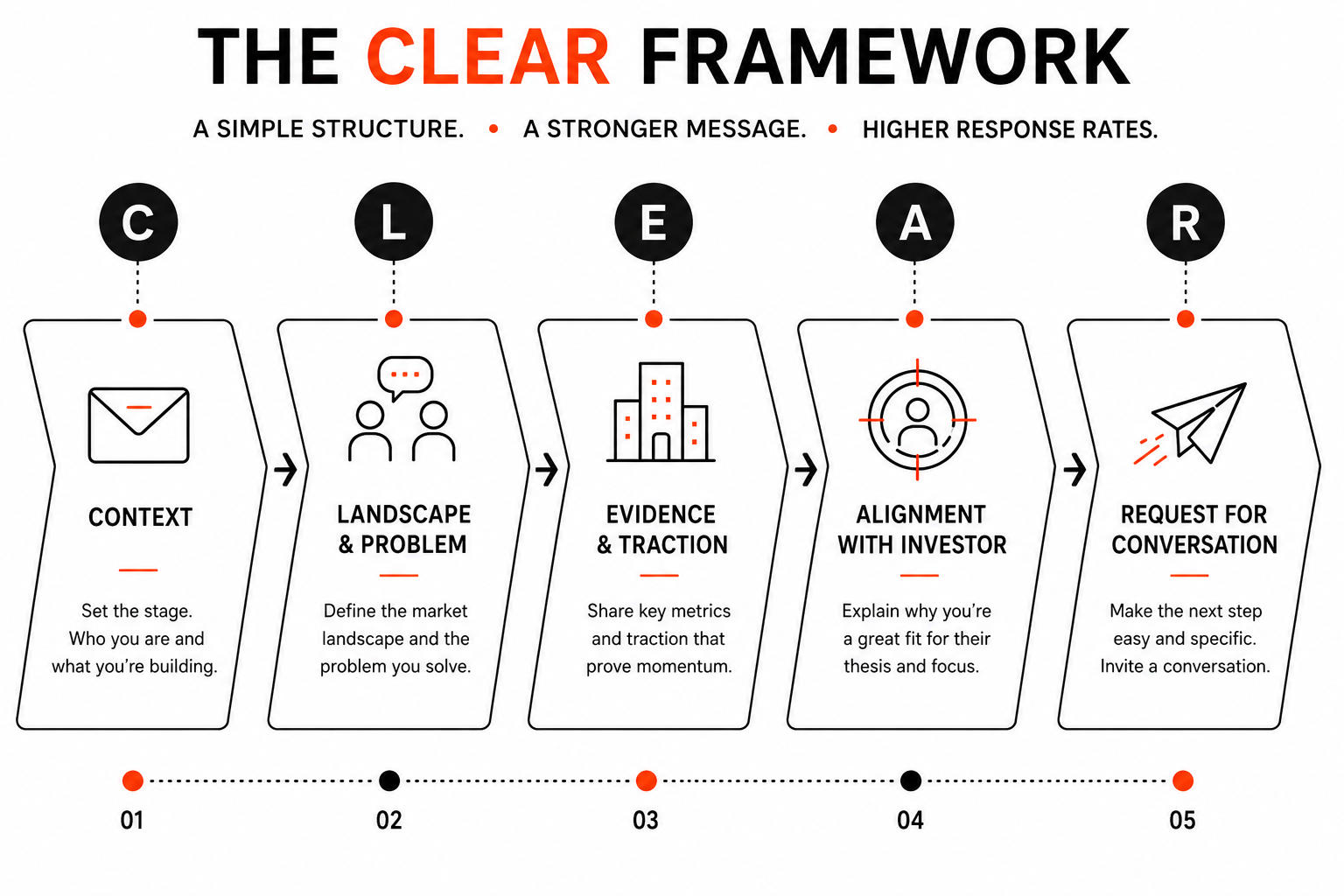
To make this process easier, use the CLEAR framework:
C — Context
L — Landscape and problem
E — Evidence and traction
A — Alignment with the investor
R — Request for conversation
This structure helps founders create emails that are concise, relevant, and focused on what investors need to know.
C — Context: Start With Why You Are Reaching Out
The first few lines should immediately establish why you are contacting this investor.
Avoid starting with a long company background or a generic introduction. Investors need to understand the connection between your startup and their investment interests.
A strong opening answers:
- Why this investor?
- Why now?
- Why is this opportunity relevant?
Example:
"I noticed that you invest in early-stage climate technology companies, including solutions focused on sustainable supply chains. We are building a platform that helps manufacturers reduce carbon emissions through real-time data tracking, and I thought this aligned with your investment focus."
The goal is to show that your email was intentionally written for them, not sent to hundreds of investors.
L — Landscape and Problem: Explain What You Are Solving
Investors invest in solutions to meaningful problems. However, founders often make the mistake of describing their product before explaining the problem.
A strong cold email briefly explains:
- Who faces the problem?
- How significant is the challenge?
- Why existing solutions are not enough?
For example:
Instead of:
"We built an AI-powered platform for healthcare providers."
Say:
"Healthcare teams spend thousands of hours each year managing administrative tasks, reducing the time available for patient care. We built an AI platform that automates documentation and reduces this workload."
The investor should understand the importance of the problem before learning about the product.
E — Evidence and Traction: Show Why Investors Should Pay Attention
A strong idea alone is rarely enough. Investors want signals that demonstrate progress and potential.
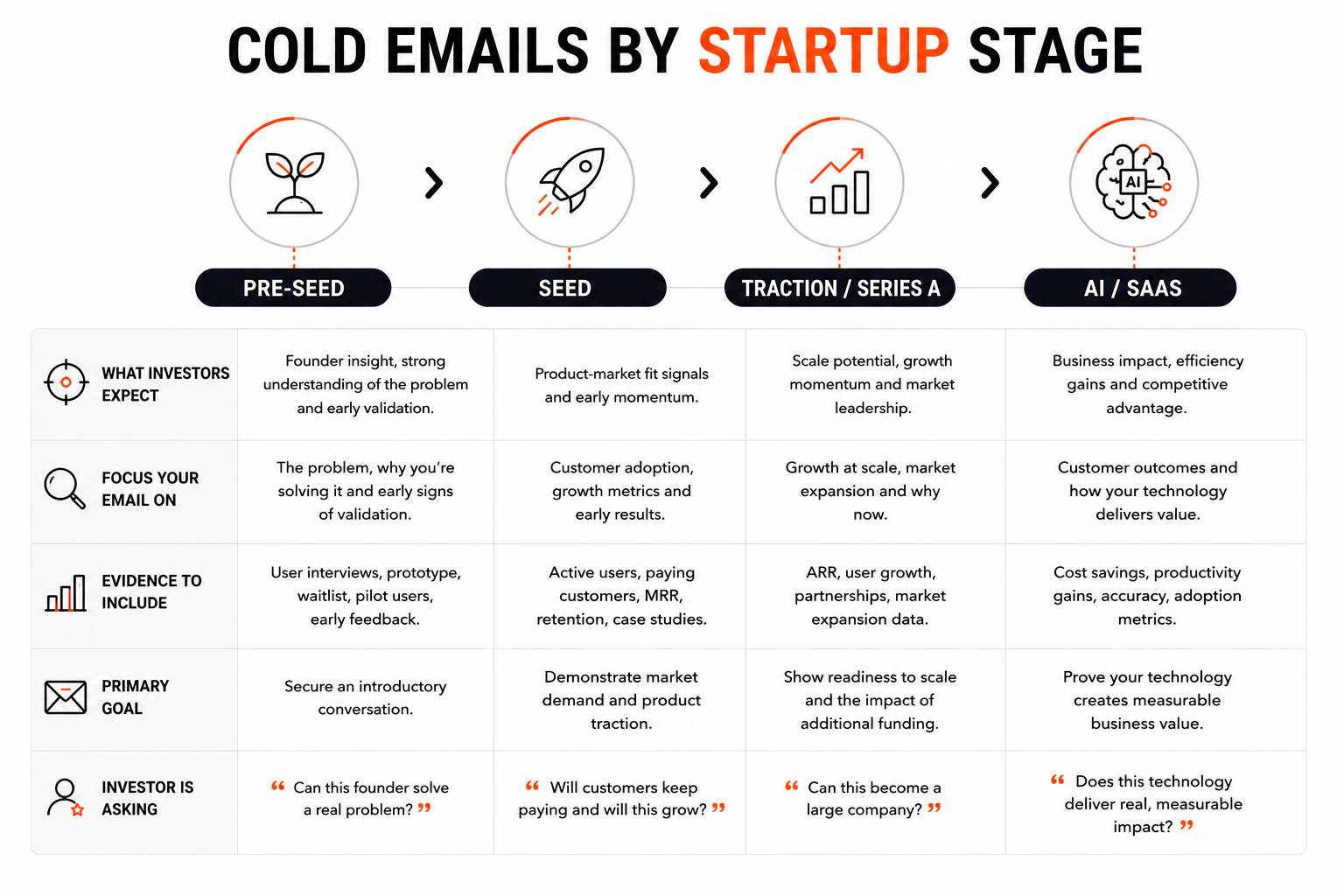
Depending on your startup stage, evidence can include:
- Revenue
- User growth
- Customer retention
- Pilot programs
- Partnerships
- Market demand
- Founder expertise
For early-stage startups without revenue, traction can still include:
- Customer interviews
- Waitlists
- Product usage
- Early partnerships
- Successful experiments
The key is to replace broad claims with measurable proof.
Instead of:
"There is huge demand for our product."
Use:
"More than 200 companies joined our waitlist before launch, and we have converted 35 early users into paying customers."
Specific evidence helps investors quickly understand momentum.
A — Alignment: Explain Why This Investor Is the Right Fit
Investors receive many startup pitches, but they are not the right match for every company.
A strong email explains why you selected them specifically.
Mention:
- Their previous investments
- Their sector expertise
- Their geographic focus
- Their stage preference
For example:
"Given your investments in B2B SaaS companies and your experience supporting early-stage founders, I thought our company could be relevant to your portfolio."
This shows preparation and increases the likelihood that your email feels relevant.
R — Request: End With a Simple Next Step
The final part of your email should make responding easy.
The goal is not to convince an investor to invest immediately. The goal is to start a conversation.
Avoid:
"Please review our pitch deck and let us know if you want to invest."
Instead, try:
"Would you be open to a 20-minute conversation to explore whether this aligns with your investment interests?"
A clear, low-pressure request gives investors an easy reason to reply.
Why the CLEAR Framework Works
The best investor cold emails reduce uncertainty. Investors need to quickly understand three things:
- What problem are you solving?
- Why should they believe this opportunity has potential?
- Why are they the right person to speak with?
The CLEAR framework helps founders answer these questions without overwhelming the reader. A successful cold email is not about saying everything—it is about including the information that creates enough confidence for the next conversation.
Subject Lines That Improve Investor Email Open Rates
Your subject line is the first thing an investor sees before deciding whether to open your email. A strong subject line does not need to be clever or overly creative—it needs to be clear, specific, and relevant to the investor.
The best investor email subject lines quickly communicate what your startup does, why it may be interesting, or what progress you have achieved. Specific details such as your industry, traction, or a clear problem you are solving can help your email stand out.
Examples of stronger subject lines:
- AI platform helping healthcare teams reduce administrative work
- SaaS startup helping small businesses automate financial reporting
- Growing to 10,000 users — raising our seed round
- Exploring alignment with your investments in climate technology
Avoid subject lines that are too vague, exaggerated, or sales-focused. They often make emails look like mass outreach and give investors no reason to open them.
Avoid:
- Investment opportunity
- Seeking funding
- Urgent: Don't miss this opportunity
- The next billion-dollar startup
- Revolutionary technology changing the world
Instead of trying to create excitement with big claims, focus on clarity and credibility. A good subject line should help investors immediately understand what you are building and why your email is relevant to them.
A simple formula to follow is:
What you build + who it helps + proof or impact
For example:
"AI tool helping retailers reduce customer support costs by 50%"
The goal of a subject line is not to secure funding—it is to earn enough interest for the investor to open your email and learn more.
Common Cold Email Mistakes Founders Make
Even strong startups can struggle to get investor replies because of small mistakes in how they approach cold outreach. A good investor email is not about sharing every detail—it is about communicating the right information clearly and making it easy for investors to understand the opportunity.
One of the most common mistakes founders make is writing emails that are too long. Investors are busy and often review opportunities quickly, so a lengthy message with too much background information can make it difficult to identify the key points. Focus on the problem, solution, traction, and reason for reaching out instead of explaining the entire startup journey.
Another mistake is being too vague. Statements like "we are transforming the future of technology" or "we are building an innovative solution" do not help investors understand what makes your company valuable. Clearly explain what you do, who you serve, and what problem you are solving.
Sending the same generic email to every investor is another missed opportunity. Investors want to see that you understand their focus and why your startup may be relevant to their portfolio. Even a small amount of personalization—such as referencing their previous investments or sector expertise—can make your outreach more meaningful.
Many founders also fail to include proof that their startup is gaining momentum. While every company is at a different stage, investors want to see evidence of progress, whether that is revenue, user growth, customer feedback, partnerships, or market validation.
Finally, a weak call to action can make it harder for investors to respond. Instead of asking for a major commitment immediately, such as a full meeting or investment decision, focus on starting a conversation with a simple and clear request.
Avoiding these mistakes does not guarantee a reply, but it increases the chances that investors can quickly understand your opportunity and see a reason to continue the conversation.
Should You Include a Pitch Deck in Your Cold Email?
A pitch deck can help investors understand your startup in more detail, but it should not replace a clear and well-written email. Your first message should create enough interest for an investor to want to learn more, while the pitch deck provides additional context about your business.
For most cold outreach, avoid attaching a large file immediately unless there is a clear reason to do so. Some investors prefer reviewing a short email first, while others may appreciate having a deck available for a quick overview.
If you include a pitch deck, make sure it is easy to access and relevant to your outreach. A simple link to your deck is often better than a large attachment. Your deck should clearly explain your problem, solution, market opportunity, business model, traction, competition, and fundraising goals.
A strong email and pitch deck should work together: the email creates interest, and the deck provides the information investors need to evaluate the opportunity further.
How to Follow Up Without Being Pushy
Not receiving a reply does not always mean an investor is not interested. Investors manage busy schedules, and a thoughtful follow-up can help bring your email back to their attention.
A good approach is to wait several days before following up rather than sending multiple messages quickly. A first follow-up after around one week is usually reasonable, with another reminder later if you have meaningful updates to share.
Your follow-up should be short and provide context. Avoid simply writing "just checking in." Instead, add something useful, such as a new milestone, customer update, product launch, or additional information that may be relevant.
For example:
"Hi [Name], I wanted to follow up on my previous email. Since reaching out, we have onboarded 20 additional customers and thought this update might be relevant to your investment focus. Would you be open to a brief conversation?"
If you have followed up multiple times without a response, it is usually best to move on. Building investor relationships is about finding the right fit, not repeatedly pursuing someone who may not be interested.
Investor Cold Email Checklist and Sample Before Sending
Before sending your investor outreach email, review the following:
✓ Is the subject line clear and specific?
✓ Does the opening explain why you contacted this investor?
✓ Can someone understand what your startup does within a few sentences?
✓ Have you included proof of progress or validation?
✓ Is the email concise and easy to read?
✓ Does it explain why this investor is a good fit?
✓ Is your call to action simple and clear?
✓ Have you checked grammar, links, and contact details?
A final review can help ensure your email communicates professionalism and makes it easier for investors to understand your opportunity.
Frequently Asked Questions
Do cold emails to investors actually work?
Yes, cold emails can help founders build relationships with investors when they are targeted, personalized, and focused on the right information. A well-researched email is more likely to receive attention than a generic message sent to a large list.
How long should an investor cold email be?
A good investor cold email should be concise and focused. Aim to communicate your startup, traction, investor fit, and next step without unnecessary details.
Should I email multiple investors at the same time?
Yes, founders often reach out to multiple relevant investors during fundraising. However, each email should still be personalized based on the investor's focus and portfolio.
Should I attach my pitch deck in the first email?
It depends on the situation. Some founders include a link to their deck, while others wait until an investor shows interest. The most important thing is that your first email clearly communicates the opportunity.
How many times should I follow up with an investor?
There is no universal rule, but a few thoughtful follow-ups are generally acceptable. If an investor does not respond after multiple attempts, it is better to focus your time on more relevant opportunities.
Conclusion: Turning Cold Emails Into Investor Conversations
Writing a successful investor cold email is not about finding the perfect words or creating a message that guarantees a reply. It is about making it easy for the right investor to understand your opportunity and see why a conversation may be worth having.
The strongest cold emails share a few common qualities: they are clear, personalized, supported by evidence, and respectful of the investor's time. They focus less on selling and more on creating a meaningful connection between the startup and the investor.
Before sending your next investor email, remember:
- Research the right investors before reaching out
- Communicate your startup's value clearly
- Highlight evidence of progress
- Personalize your message
- Make the next step simple
A cold email may only be the beginning of a relationship, but a thoughtful first message can open the door to valuable conversations, partnerships, and potential investment opportunities.
.svg)